
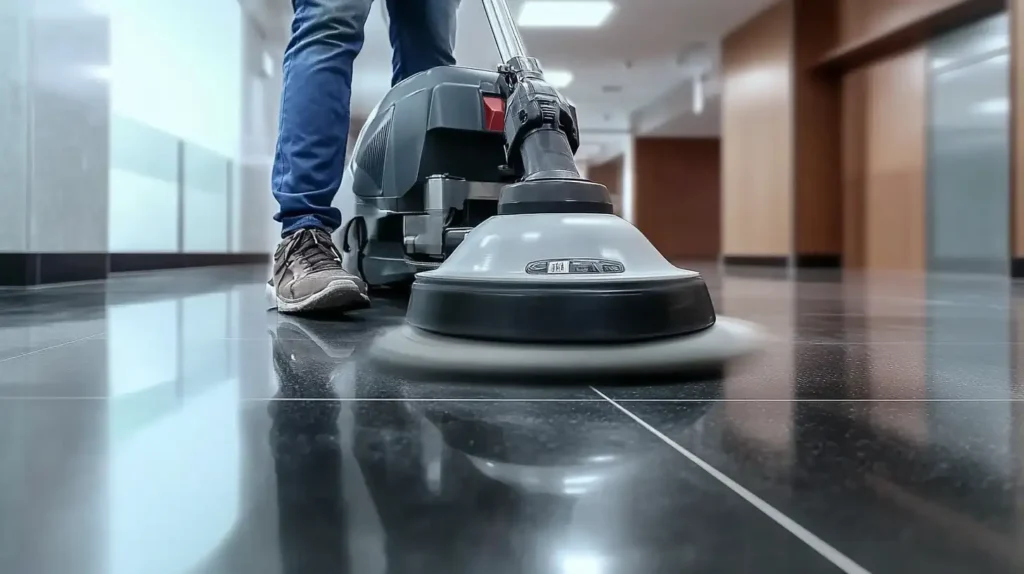
Search for what it costs to strip and wax floors and you’ll find ranges that disagree by a factor of ten. That’s because the price depends on your floor, not a national average. This guide explains how commercial strip and wax jobs are priced, what moves the number, and how to compare quotes so you pay for a result that lasts.
How strip and wax jobs are priced
Commercial floor stripping and waxing is usually quoted one of three ways:
- Per square foot. The most common method for larger floors, with the rate set by condition and number of coats.
- Per project. A flat price for a defined area, common for smaller jobs where setup time dominates.
- Bundled into a floor care program. Strips, recoats and burnishing scheduled across the year for a predictable monthly or annual cost.
Smaller jobs usually cost more per square foot because travel, setup and equipment time are spread over less floor.
What raises or lowers your price
- Floor condition. Years of built-up finish, embedded dirt or skipped maintenance take longer to strip.
- Square footage and layout. Open areas go faster than many small rooms, offices or restrooms.
- Number of coats. High-traffic floors need more coats of finish for protection, which adds material and drying time.
- Furniture and equipment. Moving desks, shelving or fixtures adds labor.
- Scheduling. After-hours, weekend or phased work to keep your building open can affect the quote.
- Floor type. VCT is the standard. LVP and many no-wax floors should not be stripped and waxed at all; see our guide on how to clean LVP flooring.
Full strip vs. scrub and recoat
A full strip and wax resets the floor to bare tile and rebuilds the finish, so it costs more. A scrub and recoat refreshes only the top layers, so it’s faster and cheaper. Most facilities save money over the year by pairing one full strip with periodic recoats instead of stripping more often. Our guide to stripping and waxing VCT floors covers the right schedule for your building type.
How to compare quotes
Ask every provider the same questions so you’re comparing like for like:
- Is this a full strip to bare tile, or a scrub and recoat?
- How many coats of sealer and finish are included?
- Is furniture moving included?
- When will the work happen, and how long will the area be closed?
- What maintenance do you recommend between strips?
A low bid that skips coats or cuts the stripping step short often looks good for a few weeks and then needs redoing.
Why a walkthrough matters
Two floors of the same size can be priced very differently because of buildup, layout and traffic. A walkthrough lets the provider see the floor’s condition, measure accurately and recommend whether you need a full strip at all.
PBS Cleaning provides free walkthroughs for floor stripping and waxing across San Diego County and can build it into a year-round commercial floor care program.
Talk to PBS Cleaning
PBS Cleaning (Personalized Building Services) has provided commercial cleaning and janitorial services across San Diego County for more than 40 years. To request a free, no-obligation walkthrough and quote for your facility, call (858) 295-2047 or visit pbscleans.com.
Frequently Asked Questions
How much does it cost to strip and wax floors?
It depends on floor condition, square footage, layout, number of coats and scheduling. Most commercial jobs are priced per square foot, as a flat project price, or as part of an annual floor care program, so a walkthrough gives the most accurate number.
Is a scrub and recoat cheaper than a full strip?
Yes. A scrub and recoat only refreshes the top layers of finish, so it takes less time and material. Pairing recoats with one full strip a year is often the most cost-effective approach.
Why do strip and wax quotes vary so much?
Providers may be quoting different scopes, such as fewer coats, no furniture moving, or a recoat instead of a full strip. Ask each provider exactly what’s included.