
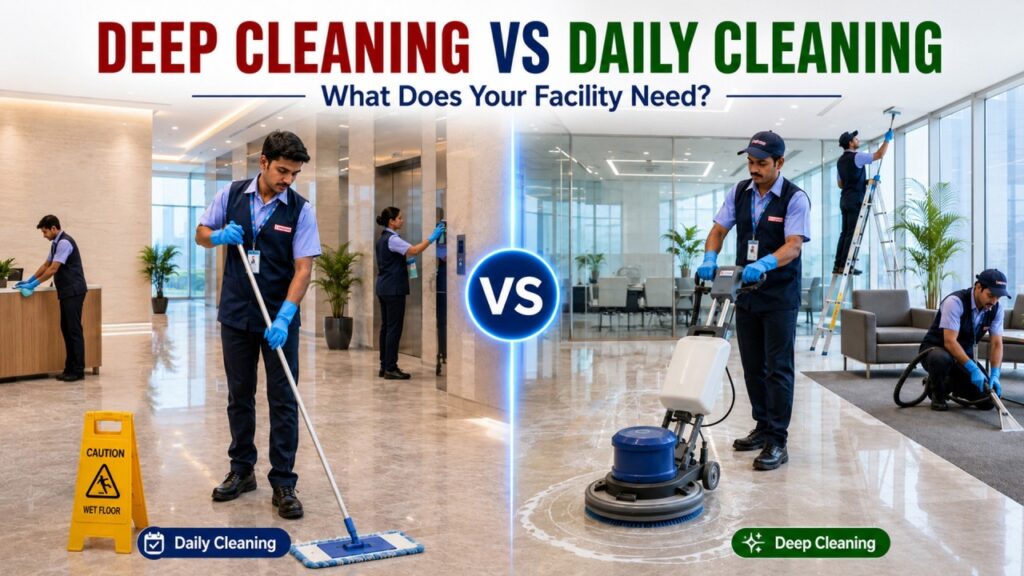
Nothing shapes how people feel about a building faster than its restrooms. A clean lobby won’t make up for an empty soap dispenser or a lingering odor. Daily janitorial cleaning keeps restrooms usable, but even well-cleaned restrooms build up grime that routine cleaning doesn’t reach. Here’s what commercial restroom cleaning should include every day, and when a deep clean is needed.
What daily commercial restroom cleaning should cover
- Clean and disinfect toilets, urinals, sinks and counters
- Disinfect high-touch points: door handles, flush handles, faucets, dispensers, stall locks and light switches
- Clean mirrors and stainless steel
- Empty trash and sanitary bins and replace liners
- Restock toilet paper, paper towels, soap and seat covers
- Sweep and mop floors with a disinfecting cleaner
- Spot-clean partitions and walls
In busy buildings, restrooms often need attention more than once a day. A day porter can check, restock and touch up restrooms during business hours so they never fall behind between nightly cleanings.
What a restroom deep clean adds
Daily cleaning handles surfaces. A deep clean goes after the buildup that causes stains, dull fixtures and odors:
- Scrubbing tile floors and walls, including the grout lines where soil and urine collect
- Descaling toilets, urinals, faucets and drains to remove mineral and hard water buildup
- Cleaning behind and underneath fixtures, toilets and urinals
- Detailing partitions, including hinges, edges and floor brackets
- Cleaning vents, light fixtures and high surfaces
- Flushing and treating floor drains
- Machine-scrubbing and rinsing the floor rather than mopping alone
How often to deep clean commercial restrooms
| Restroom traffic | Deep cleaning frequency |
|---|---|
| Heavy (retail, public buildings, busy offices) | Monthly |
| Moderate (typical offices, clinics) | Every 1–3 months |
| Light (small offices, back-of-house) | Quarterly |
Restrooms that still smell after daily cleaning, or that have darkened grout, are usually overdue.
Why restrooms keep smelling after cleaning
Lingering odors almost always have a source that daily mopping doesn’t reach: urine absorbed into grout and around the base of toilets and urinals, dry floor drain traps, or buildup under fixtures. Air fresheners only mask it. A deep clean that scrubs the grout and treats drains removes the source. Badly stained grout may need professional tile and grout cleaning.
When something goes wrong
Toilet backups and overflows need more than a mop. Wastewater requires proper cleanup and decontamination before the space is safe to use. PBS Cleaning offers same-day emergency cleanup and decontamination for floods, leaks and toilet backups across San Diego County.
Restrooms are cleaned daily as part of our janitorial services, and PBS also provides scheduled restroom deep cleaning so every corner is thoroughly addressed.
Talk to PBS Cleaning
PBS Cleaning (Personalized Building Services) has provided commercial cleaning and janitorial services across San Diego County for more than 40 years. To request a free, no-obligation walkthrough and quote for your facility, call (858) 295-2047 or visit pbscleans.com.
Frequently Asked Questions
How often should commercial restrooms be cleaned?
Commercial restrooms should be cleaned and restocked at least daily, and more often in high-traffic buildings. A deep clean is usually needed monthly to quarterly, depending on traffic.
What is included in a restroom deep clean?
A deep clean includes scrubbing tile and grout, descaling fixtures, cleaning behind and under toilets and urinals, detailing partitions, treating floor drains and machine-scrubbing the floor.
How do you get rid of restroom odors?
Remove the source. Odors usually come from urine in grout, dry drain traps or buildup under fixtures. A deep clean that scrubs grout and treats drains eliminates them better than air fresheners.